WERF Benchmark WRRF Configurations
Process flow diagrams for all 18 water resource recovery facility (WRRF)
configurations as described in In Zhang et al., 2026 . These configurations were based on the net-zero energy solutions for WRRFs report by the Water Environment Research Foundation (WERF, now a part of the Water Research Foundation, WRF) .
Source codes for these configurations can be found in the werf EXPOsan module .
To create any of the system configurations, use the following code, replacing B1 B2 C3
from exposan.werf import create_system
B1 = create_system ( 'B1' )
B1 . simulate ( method = 'BDF' , t_span = ( 0 , 400 ))
B1 . diagram ( file = 'B1' , format = 'html' )
Valid configuration codes are: B1, B2, B3, C1, C2, C3, E2, E2P, F1, G1, G2, G3, H1, I1, I2, I3, N1, N2.
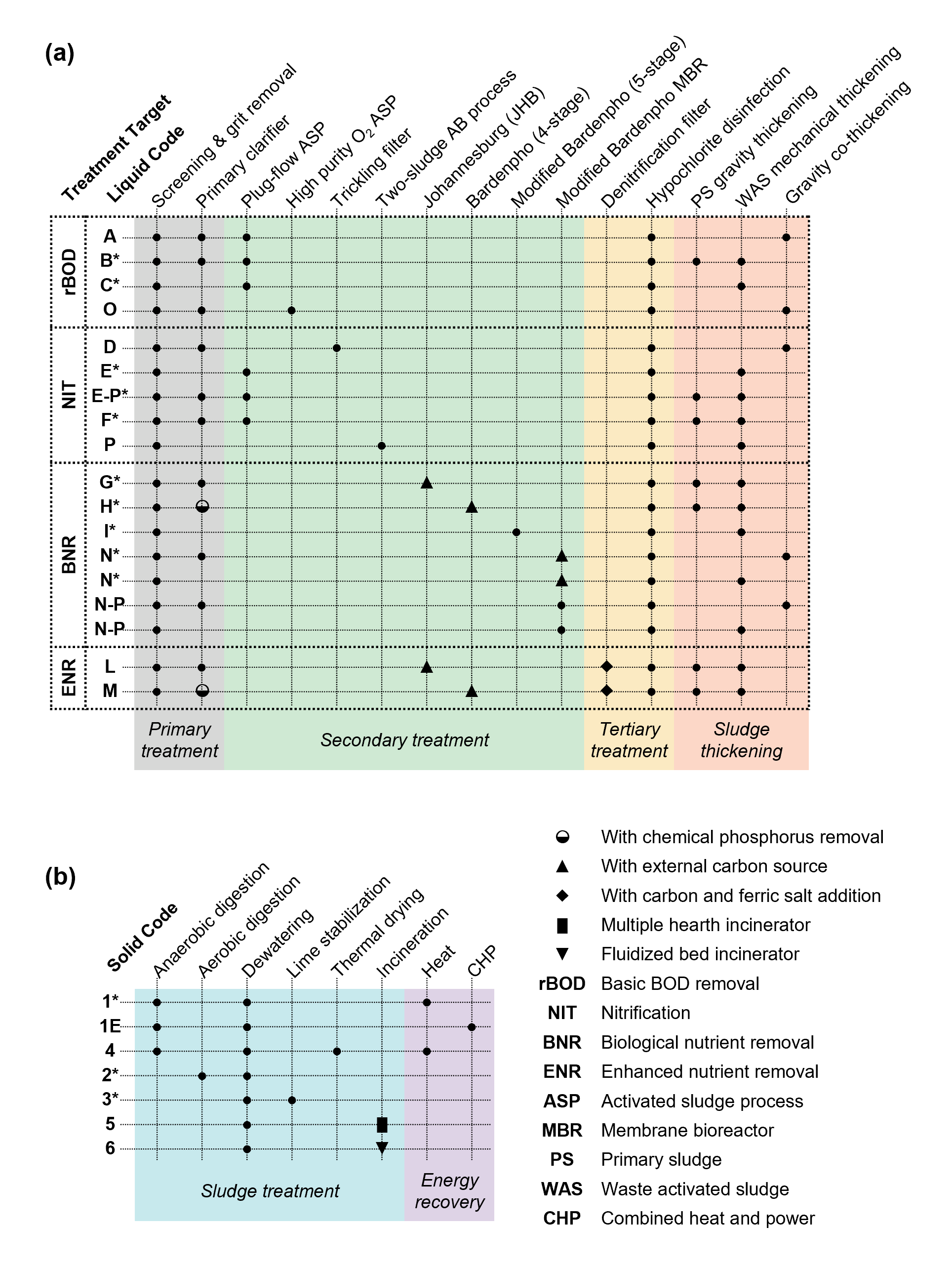
Distinguishing features of benchmark WRRF configurations. A WRRF configuration is referred to as a unique combination of a liquid code (a) and a solid code (b) as defined in . Configurations followed by a star (*) are implemented in EXPOsan
Reading the Diagrams
Every diagram uses the same convention: liquid train across the top with the
bioreactor zones in the middle, mixed-liquor recycles (MLR) above the zones,
return activated sludge (RAS) below them; solids train across the middle;
reject water (centrate + thickener supernatants) returned to the head of the
plant along the bottom.
PC SC DW
GT MT MBR
AD AED
RWW ML
PE PS
SE WAS
The configurations are categorized based on their treatment goals:
rBOD for basic BOD removal (r for readily): B (with primary clarifier) and C (without primary clarifier) series.
NIT for nitrification: E (aerobic digestion) and F series (anaerobic digestion).
BNR for biological nutrient removal: G (Johannesburg), H (4-stage Bardenpho+chemicals), I (5-stage Bardenpho), N (5-stage Bardenpho+MBR) series.
B Series: rBOD with Primary Clarifier
Conventional six-zone aerobic activated sludge with short SRT (~2 d) — only BOD
removal, nitrifiers wash out. The three B variants differ only in the solids
train (AD, AED, or no digestion).
B1 rBOD · Primary clarifier · 6-zone aerobic ASP · Anaerobic digestion LIQUID TREATMENT RWW PC PE O1 O2 O3 O4 O5 O6 ML SC Effluent RAS (return activated sludge) PS WAS SOLIDS TREATMENT GT MT AD biogas DW sludge cake reject water (centrate + thickener supernatant)
Anaerobic
Anoxic
Aerobic
Clarifier
Anaerobic dig. (AD)
Aerobic dig. (AED)
Thickener
Dewatering
Membrane (MBR)
Chemical dose
Main flow
Recycle
Sludge
Biogas
Chemical addition
B2 rBOD · Primary clarifier · 6-zone aerobic ASP · Aerobic digestion LIQUID TREATMENT RWW PC PE O1 O2 O3 O4 O5 O6 ML SC Effluent RAS PS WAS SOLIDS TREATMENT GT MT AED DW sludge cake reject water (centrate + thickener supernatant)
Anaerobic
Anoxic
Aerobic
Clarifier
Anaerobic dig. (AD)
Aerobic dig. (AED)
Thickener
Dewatering
Membrane (MBR)
Chemical dose
Main flow
Recycle
Sludge
Biogas
Chemical addition
B3 rBOD · Primary clarifier · 6-zone aerobic ASP · No digestion (thickening + dewatering only) LIQUID TREATMENT RWW PC PE O1 O2 O3 O4 O5 O6 ML SC Effluent RAS PS WAS SOLIDS TREATMENT GT MT DW sludge cake reject water (centrate + thickener supernatant)
Anaerobic
Anoxic
Aerobic
Clarifier
Anaerobic dig. (AD)
Aerobic dig. (AED)
Thickener
Dewatering
Membrane (MBR)
Chemical dose
Main flow
Recycle
Sludge
Biogas
Chemical addition
C Series: rBOD without Primary Clarifier
Same six-zone aerobic activated sludge as the B series but without primary clarification — all influent organics enter the bioreactor directly, increasing aeration demand. The three C variants differ only in the solids train (AD, AED, or no digestion).
C1 rBOD · No primary clarifier · 6-zone aerobic ASP · Anaerobic digestion LIQUID TREATMENT RWW O1 O2 O3 O4 O5 O6 ML SC Effluent RAS WAS SOLIDS TREATMENT MT AD biogas DW sludge cake reject water (centrate + thickener supernatant)
Anaerobic
Anoxic
Aerobic
Clarifier
Anaerobic dig. (AD)
Aerobic dig. (AED)
Thickener
Dewatering
Membrane (MBR)
Chemical dose
Main flow
Recycle
Sludge
Biogas
Chemical addition
C2 rBOD · No primary clarifier · 6-zone aerobic ASP · Aerobic digestion LIQUID TREATMENT RWW O1 O2 O3 O4 O5 O6 ML SC Effluent RAS WAS SOLIDS TREATMENT MT AED DW sludge cake reject water (centrate + thickener supernatant)
Anaerobic
Anoxic
Aerobic
Clarifier
Anaerobic dig. (AD)
Aerobic dig. (AED)
Thickener
Dewatering
Membrane (MBR)
Chemical dose
Main flow
Recycle
Sludge
Biogas
Chemical addition
C3 rBOD · No primary clarifier · 6-zone aerobic ASP · No digestion (thickening + dewatering only) LIQUID TREATMENT RWW O1 O2 O3 O4 O5 O6 ML SC Effluent RAS WAS SOLIDS TREATMENT MT DW sludge cake reject water (centrate + thickener supernatant)
Anaerobic
Anoxic
Aerobic
Clarifier
Anaerobic dig. (AD)
Aerobic dig. (AED)
Thickener
Dewatering
Membrane (MBR)
Chemical dose
Main flow
Recycle
Sludge
Biogas
Chemical addition
E Series: NIT with Aerobic Digestion
Longer SRT (~6 d) retains nitrifiers for NH₄⁺ oxidation. E2-P adds primary clarification to the E2 liquid train.
E2 NIT · No primary clarifier · Nitrifying ASP · Aerobic digestion LIQUID TREATMENT RWW O1 O2 O3 O4 O5 O6 ML SC Effluent RAS WAS SOLIDS TREATMENT MT AED DW sludge cake reject water (centrate + thickener supernatant)
Anaerobic
Anoxic
Aerobic
Clarifier
Anaerobic dig. (AD)
Aerobic dig. (AED)
Thickener
Dewatering
Membrane (MBR)
Chemical dose
Main flow
Recycle
Sludge
Biogas
Chemical addition
E2-P NIT · Primary clarifier ("prime" variant) · Nitrifying ASP · Aerobic digestion LIQUID TREATMENT RWW PC PE O1 O2 O3 O4 O5 O6 ML SC Effluent RAS PS WAS SOLIDS TREATMENT GT MT AED DW sludge cake reject water (centrate + thickener supernatant)
Anaerobic
Anoxic
Aerobic
Clarifier
Anaerobic dig. (AD)
Aerobic dig. (AED)
Thickener
Dewatering
Membrane (MBR)
Chemical dose
Main flow
Recycle
Sludge
Biogas
Chemical addition
F Series: NIT with Anaerobic Digestion
Compared to E2-P, F1 differs in solids treatment by using anaerobic digestion.
F1 NIT · Primary clarifier · Nitrifying ASP · Anaerobic digestion LIQUID TREATMENT RWW PC PE O1 O2 O3 O4 O5 O6 ML SC Effluent RAS PS WAS SOLIDS TREATMENT GT MT AD biogas DW sludge cake reject water (centrate + thickener supernatant)
Anaerobic
Anoxic
Aerobic
Clarifier
Anaerobic dig. (AD)
Aerobic dig. (AED)
Thickener
Dewatering
Membrane (MBR)
Chemical dose
Main flow
Recycle
Sludge
Biogas
Chemical addition
G Series: BNR with Johannesburg Process
BNR configurations with primary clarification. G1–G3 use the Johannesburg step-fed process with external carbon for EBPR;
G1 BNR · Primary clarifier · Johannesburg process (step-fed) · Anaerobic digestion LIQUID TREATMENT RWW PC A1 A2 A3 A4 O5 O6 80% 20% External C MLR (internal recycle) ML SC Effluent RAS PS WAS SOLIDS TREATMENT GT MT AD biogas DW sludge cake reject water (centrate + thickener supernatant)
Anaerobic
Anoxic
Aerobic
Clarifier
Anaerobic dig. (AD)
Aerobic dig. (AED)
Thickener
Dewatering
Membrane (MBR)
Chemical dose
Main flow
Recycle
Sludge
Biogas
Chemical addition
G2 BNR · Primary clarifier · Johannesburg process (step-fed) · Aerobic digestion LIQUID TREATMENT RWW PC A1 A2 A3 A4 O5 O6 80% 20% External C MLR (internal recycle) ML SC Effluent RAS PS WAS SOLIDS TREATMENT GT MT AED DW sludge cake reject water (centrate + thickener supernatant)
Anaerobic
Anoxic
Aerobic
Clarifier
Anaerobic dig. (AD)
Aerobic dig. (AED)
Thickener
Dewatering
Membrane (MBR)
Chemical dose
Main flow
Recycle
Sludge
Biogas
Chemical addition
G3 BNR · Primary clarifier · Johannesburg process (step-fed) · No digestion (thickening + dewatering only) LIQUID TREATMENT RWW PC A1 A2 A3 A4 O5 O6 80% 20% External C MLR (internal recycle) ML SC Effluent RAS PS WAS SOLIDS TREATMENT GT MT DW sludge cake reject water (centrate + thickener supernatant)
Anaerobic
Anoxic
Aerobic
Clarifier
Anaerobic dig. (AD)
Aerobic dig. (AED)
Thickener
Dewatering
Membrane (MBR)
Chemical dose
Main flow
Recycle
Sludge
Biogas
Chemical addition
H Series: BNR with Chemical P Removal
H1 combines chemical phosphorus removal (Fe:sup:3+ /Al:sup:3+ ) with a 4-stage Bardenpho bioreactor and external carbon.
H1 BNR · Primary clarifier + chemical P removal · Modified 5-stage Bardenpho · Anaerobic digestion LIQUID TREATMENT RWW PC Coagulant PE Anae Anox Aer Aer Anox Aer External C MLR (internal recycle) ML SC Effluent RAS PS WAS SOLIDS TREATMENT GT MT AD biogas DW sludge cake reject water (centrate + thickener supernatant)
Anaerobic
Anoxic
Aerobic
Clarifier
Anaerobic dig. (AD)
Aerobic dig. (AED)
Thickener
Dewatering
Membrane (MBR)
Chemical dose
Main flow
Recycle
Sludge
Biogas
Chemical addition
I Series: BNR with 5-stage Bardenpho
Five-stage Bardenpho without primary clarification — raw wastewater provides carbon for denitrification and EBPR without external dosing. The three I variants differ only in the solids train (AD, AED, or no digestion).
I1 BNR · No primary clarifier · 5-stage Bardenpho · Anaerobic digestion LIQUID TREATMENT RWW Anae Anox Aer Aer Anox Aer MLR (internal recycle) ML SC Effluent RAS WAS SOLIDS TREATMENT MT AD biogas DW sludge cake reject water (centrate + thickener supernatant)
Anaerobic
Anoxic
Aerobic
Clarifier
Anaerobic dig. (AD)
Aerobic dig. (AED)
Thickener
Dewatering
Membrane (MBR)
Chemical dose
Main flow
Recycle
Sludge
Biogas
Chemical addition
I2 BNR · No primary clarifier · 5-stage Bardenpho · Aerobic digestion LIQUID TREATMENT RWW Anae Anox Aer Aer Anox Aer MLR (internal recycle) ML SC Effluent RAS WAS SOLIDS TREATMENT MT AED DW sludge cake reject water (centrate + thickener supernatant)
Anaerobic
Anoxic
Aerobic
Clarifier
Anaerobic dig. (AD)
Aerobic dig. (AED)
Thickener
Dewatering
Membrane (MBR)
Chemical dose
Main flow
Recycle
Sludge
Biogas
Chemical addition
I3 BNR · No primary clarifier · 5-stage Bardenpho · No digestion (thickening + dewatering only) LIQUID TREATMENT RWW Anae Anox Aer Aer Anox Aer MLR (internal recycle) ML SC Effluent RAS WAS SOLIDS TREATMENT MT DW sludge cake reject water (centrate + thickener supernatant)
Anaerobic
Anoxic
Aerobic
Clarifier
Anaerobic dig. (AD)
Aerobic dig. (AED)
Thickener
Dewatering
Membrane (MBR)
Chemical dose
Main flow
Recycle
Sludge
Biogas
Chemical addition
N Series: BNR with MBR
Five-stage Bardenpho liquid train with a completely-mixed membrane bioreactor (MBR) replacing the conventional secondary clarifier. N1 includes primary clarification and anaerobic digestion; N2 omits primary clarification and uses aerobic digestion.
N1 BNR · Primary clarifier · 5-stage Bardenpho with membrane bioreactor · Anaerobic digestion LIQUID TREATMENT RWW PC PE Anae Anox Aer Aer Anox MBR External C MLR (internal recycle) Effluent MBR mixed-liquor recycle PS WAS SOLIDS TREATMENT MT AD biogas DW sludge cake reject water (centrate + thickener supernatant)
Anaerobic
Anoxic
Aerobic
Clarifier
Anaerobic dig. (AD)
Aerobic dig. (AED)
Thickener
Dewatering
Membrane (MBR)
Chemical dose
Main flow
Recycle
Sludge
Biogas
Chemical addition
N2 BNR · No primary clarifier · 5-stage Bardenpho with membrane bioreactor · Aerobic digestion LIQUID TREATMENT RWW Anae Anox Aer Aer Anox MBR External C MLR (internal recycle) Effluent MBR mixed-liquor recycle WAS SOLIDS TREATMENT MT AED DW sludge cake reject water (centrate + thickener supernatant)
Anaerobic
Anoxic
Aerobic
Clarifier
Anaerobic dig. (AD)
Aerobic dig. (AED)
Thickener
Dewatering
Membrane (MBR)
Chemical dose
Main flow
Recycle
Sludge
Biogas
Chemical addition