Systems
This page documents the systems that have been/is being developed using QSDsan with links to the source codes in GitHub and publications.
Benchmark Simulation Models
The Modelling and Integrated Assessment (MIA) Specialist Group of the International Water Association has established benchmark simulation models (BSMs) to provide a consistent environment for wastewater treatment plant (WWTP)/water resource recovery facility (WRRF) evaluation (see BSM webpage and MATLAB implementation and report).
When publishing the paper that introduces QSDsan [1], we validated the process modeling and dynamic simulation capacities of QSDsan through BSM1 (bsm1 EXPOsan module, bsm1 archived codes). BSM2 is also implemented in EXPOsan.
Water Resource Recovery Facilities
In Zhang et al., 2026 [2], we developed 18 benchmark combinations of liquid and solid treatment trains, which cover over 70% of the total treatment capacity of publicly owned treatment works (POTWs) in the Contiguous United States. These configurations were based on the Water Environment Research Foundation (WERF, now a part of the Water Research Foundation, WRF), report on net-zero energy solutions for WRRFs [3].
These simulation models have been implemented in the werf EXPOsan module. More details can be found in the interactive page.
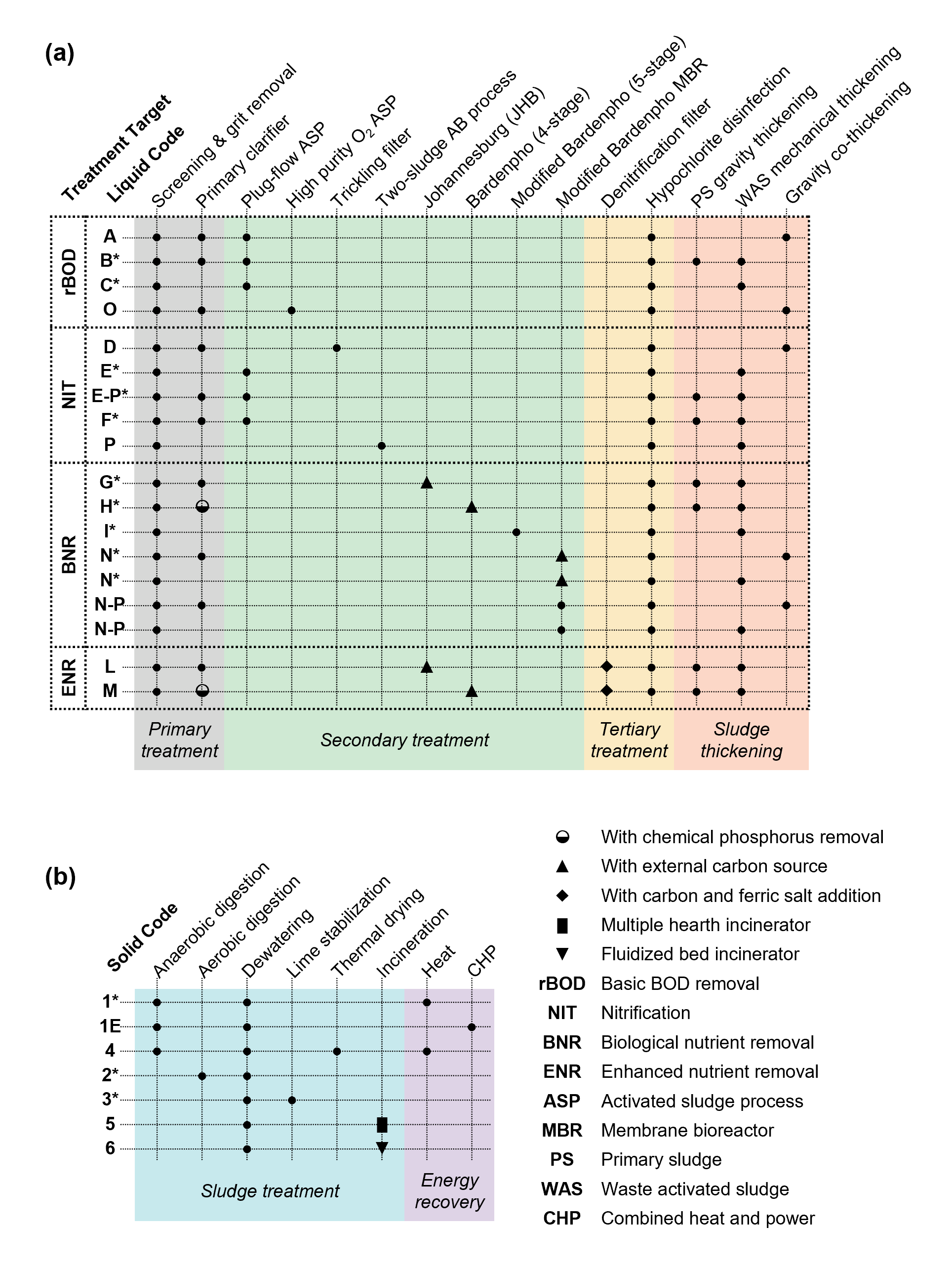
Distinguishing features of benchmark WRRF configurations. A WRRF configuration is referred to as a unique combination of a liquid code (a) and a solid code (b) as defined in [2]. Configurations followed by a star (*) are implemented in EXPOsan.
Non-sewered sanitation systems (NSSSs)
Biogenic Refinery
Publication: Rowles et al., 2022 [4]
Bwaise
Publication: Trimmer et al., 2020 [5]
bwaise Trimmer et al archived codes; bwaise Li and Zhang et al archived codes
Eco-San
NEWgenerator
Publication: Watabe et al., 2023 [6]
Reclaimer
SCG Zyclonic
Other Systems
A variety of other sanitation and resource recovery systems have been developed using QSDsan, including:
Conventional activated sludge process
Publication: Shoener et al., 2016 [7]
Hydrothermal systems for fuel and fertilizer production from wet organic wastes
Publication: Feng et al., 2024 [8]
Modular encapsulated two-stage anaerobic biological (METAB) system
Publication: Zhang et al., 2024 [9]
EcoRecover system: microalgae-based tertiary P recovery process
Publication: Kim et al., 2025 [10]